
Custom Jewelry Wholesale MOQ by Base Material
Three base metals, three floors, one rule: the published minimum is counted per design, not per order. artisan brass with recycled content, 925 silver and stainless steel at 100+. Everything else in a wholesale brief — plating, stones, hallmarks, packaging — sits on top of that floor, so it pays to understand what each metal forces the factory to do.
Key takeaways
- Entry quantities are 100 in artisan eco-brass, 50 units in sterling silver and 100+ pieces in stainless, counted per design, and the arithmetic repeats for every added design.
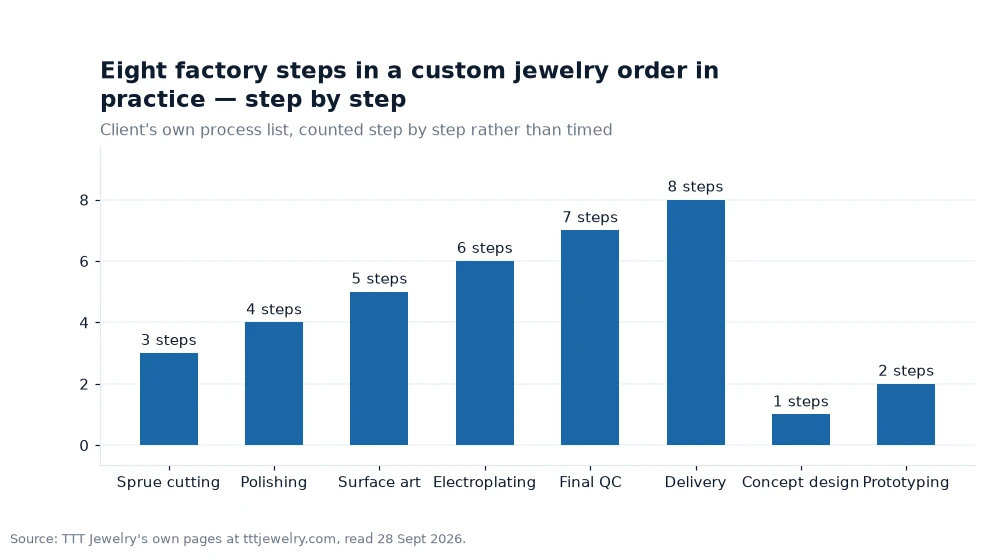
- Eight factory steps run from concept design to delivery, with 100% inspection before anything ships.
- Brass and silver take multi-layer gold or rhodium plating plus an anti-tarnish e-coating; stainless steel takes PVD.
- Purity marks are laser engraved as 18KGP for gold-plated pieces, 316L for stainless steel and an S925 stamp to match whatever the listing claims.
Why each metal has its own floor
Silver is the easiest of the three to put into production. It casts at a lower temperature, files and polishes quickly, and can be finished without a plated layer if the design calls for a white-metal look. Those qualities are why the published floor is the lowest of the three at 50 pieces per design.
Brass behaves differently. As a base metal it does not hold a retail colour on its own, so it needs an electroplated stack and a protective coat before it looks finished. That plating step is a batch operation with its own setup, and the published floor of 100 pieces per design reflects it. Stainless steel is the hardest of the three to shape and is finished by PVD vacuum plating, which is why the floor reads 100+ rather than 100.
The eight steps the material travels through
Whatever the metal, the published route is the same eight operations: concept design by hand and CAD, prototyping by mould or 3D printing, sprue cutting, high-gloss polishing, brushed and textured surface work, electroplating, final inspection and delivery. The step list matters to a buyer because it shows where a metal changes the processing rather than the paperwork.
Compare the middle of that list between materials. Brass and silver pieces are typically cast and then polished before they enter a plating tank; stainless steel is shaped by machining or stamping and then PVD coated. The last two steps are identical for all three metals, which is why a 100% inspection point before packing is published across the range.
Reading MOQ as a per-design figure
The most expensive misreading of a wholesale floor is treating it as an order minimum. It is per design. A brand ordering, with the figure repeating design by design same, which a second design simply doubles. The difference is working capital sitting in a stock room, not a difference in the quality of the piece.
That arithmetic shapes the sensible first collection. One hero design in 925 sterling silver, priced higher and made in a smaller run, with two or three plated brass designs behind it at 100 pieces each, is the common structure for a new label entering a custom jewelry wholesale program without over-committing to a single metal.
Finishing routes by metal
The finish list: 14K, 18K or 24K gold, plus rhodium, then anti-tarnish e-coating (silver and brass) and PVD for steel.
Hallmarks are applied at the same stage by high-precision laser engraving, with S925 for silver, 316L for stainless steel and 18KGP for gold-plated pieces. Chains and findings, natural stones and freshwater pearls, and the packaging set complete the specification. Each of these is a published customisation field rather than an add-on to negotiate later.
| Base material | MOQ per design | Finishing route published |
|---|---|---|
| 925 sterling silver | 50 pcs | Multi-layer gold or rhodium plating, anti-tarnish e-coating |
| Artisan eco-brass | 100 pcs | Multi-layer gold or rhodium plating, anti-tarnish e-coating |
| Stainless steel | 100+ pcs | PVD vacuum plating |
| Hallmarks | Set with the design | Laser engraved as S925, 316L or 18KGP |
| Inspection | Every order | 100% inspected before delivery |
Worked example: what a three-design range commits
Take a label that wants three designs and asks what each metal costs in commitment rather than cash. In silver: 3 × 50 = 150 pieces. In artisan eco-brass: 3 × 100 = 300 pieces. In stainless steel, using the published floor of 100+ as a hundred-piece base: 3 × 100 = 300 pieces plus the plus.
Now put the finishes next to those numbers. Silver and brass share the same plating family, so three brass designs and three silver designs can both be quoted on the same protective e-coating line, while stainless steel leaves that line entirely and moves to PVD. That is why mixing metals in one collection is workable, but the mixed order takes longer to schedule than a single-metal one.
What a floor does not cover
A minimum does not include repeat tooling, and it does not remove the sampling block. CAD is published at a 48-hour CAD turnaround, a 25–30 day sampling window and 3–4 weeks of production, and those windows apply to a 50-piece run exactly as they apply to a 5,000-piece one. A buyer planning a launch around a low floor should plan the schedule around the sample, not around the quantity.
The second thing a floor does not cover is exclusivity by default. The published position is a 100% NDA with designs kept 100% exclusive to the buyer's brand, meaning moulds, CAD files and the collection are not resold or displayed for anyone else. It is worth confirming that in writing before a first order, because a low minimum with shared tooling is a very different product from a low minimum with your own mould.
Frequently asked questions
Is the MOQ per order or per design?
Per design. Published minimums are 100 units in artisan brass, 50 pcs in 925 sterling silver and 100 plus in stainless work, by design, doubling the moment a second design is added.
Does a low MOQ change the sampling time?
No. CAD comes back in under 48 hours and the master sample still takes 25–30 days, because the sample work is per design rather than per unit.
Which metal should carry a first wholesale range?
925 sterling silver for the hero piece at 50 pieces per design, with artisan eco-brass designs behind it at 100 pieces each if a plated finish is acceptable.
Planning a first range
Write the number of designs down first, multiply by the floor for the metal you have chosen, and see whether the total is stock you can sell. Three designs is usually the point where a new label should stop and test the market. If brass is the intended look, read how the brass jewelry production line is plated and coated, and check the buyer FAQ list for the questions that come up before a first order is placed.
Where the numbers come from — the five service steps; sampling inside 25–30 days as well as the six customisation points — is the maker's own site through tttjewelry.com, which I read through on 28 Sept 2026. Any conversion into other units is my own, while the source figures stay the client's[1].