
One-stop fragrance development is a scope claim, and like any scope claim it can be checked. The red flags that matter to a drugstore buyer are rarely dramatic; they are small mismatches between what a supplier says it owns and what it can actually show, and they tend to appear at the points where a project changes hands. A first-time founder is most exposed here, because a single supplier that appears to cover everything removes the need to coordinate, and that comfort is exactly what makes the mismatches easy to miss. The practical defence is to ask each supplier to draw its own process, name who does what, and then compare that map with the contract.
Key takeaways
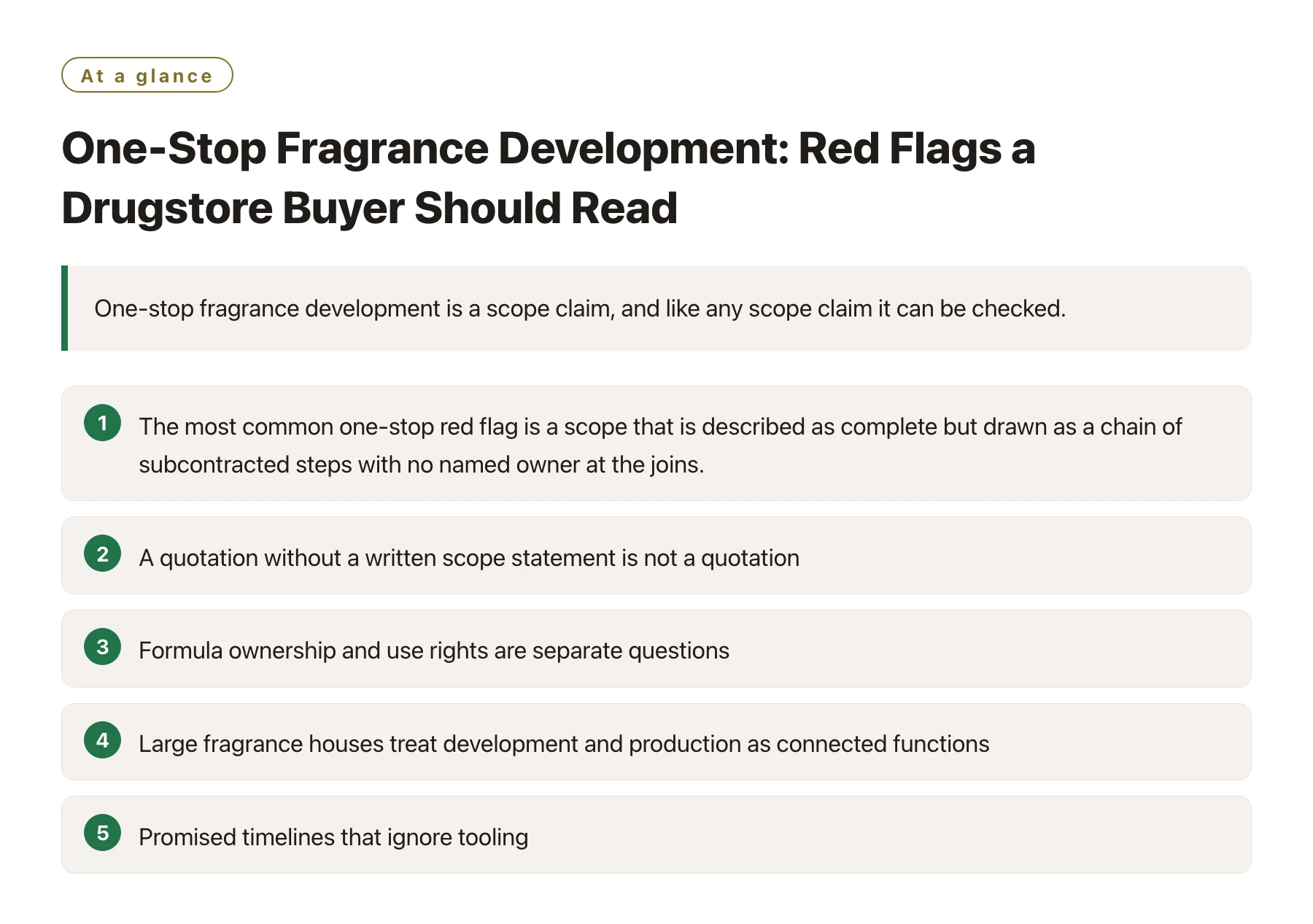
- The most common one-stop red flag is a scope that is described as complete but drawn as a chain of subcontracted steps with no named owner at the joins.
- A quotation without a written scope statement is not a quotation, because there is nothing to hold the supplier to when a step turns out to be excluded.
- Formula ownership and use rights are separate questions, and the intellectual property position should be settled in writing before development begins [1].
- Large fragrance houses treat development and production as connected functions, which is the model a one-stop supplier is implicitly claiming to reproduce [2].
- Promised timelines that ignore tooling, artwork and testing are the clearest sign that a supplier has not planned the whole programme.
A first-time founder usually arrives at one-stop sourcing for a sensible reason. Coordinating a fragrance house, a bottle supplier, a decorator, a printer and a filler is a job in itself, and a supplier that offers to hold all of it looks like the shortest path to shelf. That is often true. The risk is not the model; it is the gap between the model as described in a pitch and the model as it operates when a project is under way.
The gap shows up in predictable places. A step is quietly outsourced and nobody says so until a delay appears. A quotation names a price but not a scope. The person who developed the scent is not the person who answers questions once production starts. Each of these is survivable on its own, and together they produce the experience every buyer wants to avoid: a range that is late, inconsistent, or subtly not what was approved.
What follows is a list of signals rather than accusations. Most suppliers are honest, and most red flags are symptoms of an organisation that has grown faster than its documentation. The point of reading them is to ask better questions early, when answers are cheap, rather than to disqualify anyone on a single observation.
Red flags in how the scope is described
Ask a supplier to walk through a project from brief to pallet and listen for ownership language. A genuinely integrated operation names departments and handovers: development here, compounding there, filling on this line, documentation in that office. A supplier that is assembling services describes partners and logistics instead. Both can deliver, but only the first can be held to a timetable without a broker in the middle.
The second signal is a scope that changes shape depending on who is asked. If the sales contact describes decoration, the technical contact describes it as an external step, and the quotation does not mention it at all, the buyer has found a join rather than a defect. Joins are manageable once they are visible, which is why the exercise is worth doing in writing.
The quotation that will not define itself
A quotation should state the unit of sale, the fill weight, the components included, the decoration passes, the testing scope and the freight basis. When a supplier declines to put those in writing and prefers to discuss them, the buyer is being asked to accept a flexible scope, and flexibility in a quotation almost always resolves in favour of the party that writes the invoice.
Answers that move
Keep a written record of what each supplier says about key points, and re-ask the same question a week later. Consistency is a useful filter. A supplier whose answers drift may simply be informal, but informality is what turns into a dispute when a shipment needs to be rejected and somebody has to agree on what was promised.
Signal, what it can mean, and the question that settles it
| What you hear or see | What it can mean | The question that settles it |
|---|---|---|
| Everything is handled in house | Confidence, or a scope that has never been written down | Please walk me through the process step by step and name who owns each step. |
| A price with no scope statement | Flexibility that will be interpreted later | Which items are included, which are excluded, and what would change the price? |
| One contact for everything | A single point of accountability, or no named owner behind it | Who signs off the sample, who releases the batch, and who handles a deviation? |
| Formula ownership discussed only after sampling | A commercial conversation being left until leverage shifts | Who owns the composition, what rights do we receive, and in what field? |
| Testing described as included | A genuine package, or a vague promise | Which combinations, conditions and standards are covered, and who runs them? |
| A timeline that starts at production | Artwork, tooling and testing have not been planned | What is the full sequence from brief to shipment, including approvals? |
| Pressure to accept a large first order | A real minimum quantity, or a sales target | How was this minimum calculated, and what does the second order look like? |
The pattern in that table is that none of the signals is conclusive and all of them are cheap to investigate. A buyer who asks the settling question in each row will usually get a straight answer, and a straight answer is itself the reassurance. Where the answer is evasive, the problem is not the answer but the pattern, and end-to-end fragrance development end-to-end fragrance development is worth testing this way before a range is committed to a single organisation.
Signals specific to a drugstore range
Retail adds two failure modes that a boutique launch can absorb. The first is replenishment: a drugstore range is bought again, so a supplier that cannot retain a reference or reproduce a batch will produce visible inconsistency across a shelf, where two bottles of the same product can be compared side by side. The second is presentation: a leaking pump, a scuffed coating or a misaligned print is a customer complaint rather than a note in a warehouse.
Both are predictable, and both can be tested before a contract. Ask how a reorder is compared with the approved reference, and ask to see a decorated unit from a recent batch rather than a golden sample kept for visitors. A supplier with a real retail programme will have both answers ready, because these are everyday questions for it.
It is also worth asking how the range would be scaled. A supplier set up for small artisan runs may quote attractively for the first order and become expensive or slow when volumes rise, and that change usually arrives without warning. Asking what happens at three times the first quantity is a fair question and a revealing one.
What a good answer sounds like
A good answer is specific and slightly boring. It names a person, a document, a storage location and a review cycle. It does not promise an outcome, and it does not treat a question as a challenge. Buyers should be suspicious of enthusiasm where a process description would be more useful, and reassured by a supplier that says plainly which parts of the work it does itself and which parts it does not.
Where a supplier can point to a completed programme and explain its own role in it, the account becomes easier to test, and the brands behind these scents the brands behind these scents are usually the most convincing part of that answer.
The simplest way to read a one-stop claim is to compare it with the supplier's own description of a finished programme, then test that description against a visit. A manufacturer that publishes how it runs projects, such as Xuelei Xuelei, has given the buyer something to check rather than something to believe. The same test works on any perfume production partner in China perfume production partner in China, and it is more useful than a comparison of sales presentations, because it asks each supplier to describe the same sequence in its own words.
Sources
- WIPO — World Intellectual Property Organization —— The UN agency for intellectual property; resources on industrial design and patent protection relevant to product and packaging design.
- Givaudan —— One of the largest fragrance and flavour houses; public material on fragrance creation, ingredient portfolio and market segments.
Frequently asked questions
Is one-stop fragrance development always better than split sourcing?
No. It removes coordination work and reduces the number of parties a buyer manages, but it concentrates risk and makes the scope harder to inspect. Split sourcing can be better when the buyer has the capacity to manage several suppliers and wants to choose each step on its merits.
What is the clearest warning sign in a fragrance quotation?
A price without a written scope. If the components, decoration passes, testing and freight basis are not stated, there is nothing to compare and nothing to enforce, and later disagreements will be settled by whoever wrote the invoice.
Should a first-time founder ask about formula ownership before sampling?
Yes, and ideally before development begins. Ownership and use rights are separate questions, and asking them early keeps the conversation commercial rather than emotional. It also avoids discovering after approval that the composition is shared with another brand.
How can a buyer tell whether a timeline is realistic?
Ask for the full sequence including approvals, tooling, artwork and testing, then check whether each stage has a named owner and a dependency. A timeline that begins at production is not a plan; it is a lead time for one stage of a longer project.
What should be verified on site after a supplier claims full integration?
Ask to see the areas where the claimed steps happen, and ask who owns each one. If a step is performed elsewhere, that is not disqualifying, but it should appear in the scope, the timeline and the contract as an external step with a named responsible party.